How to Read Tarot Cards for Beginners
A practical, step-by-step method for your first readings – no memorising 78 definitions required.
Most beginners believe they must memorise 78 card meanings before they can read Tarot. You do not. Reading is closer to learning a language than learning a list: once you understand a few patterns – suits, numbers, images and positions – you can make sense of cards you have never studied. This guide gives you a method you can use from your very first reading.
1. Start by looking, not by looking it up
Before you read any definition, spend thirty seconds with the image. Ask yourself:
- What is happening in this scene?
- How does the main figure seem to feel?
- What stands out first – a colour, an object, a gesture?
- If this picture were about my question, what would it be saying?
The Rider-Waite-Smith images were designed to be read this way. In the Five of Cups, a cloaked figure stares at three spilled cups while two full cups stand behind them, unnoticed. You can understand grief and missed comfort without a book. Your first impression is a valid starting point; the traditional meaning then adds depth and corrects anything you have misread.
2. Use the suit to know the area of life
Each Minor Arcana card belongs to one of four suits, and the suit tells you what kind of experience the card is about:
- Wands: drive, passion, projects, creativity.
- Cups: feelings, love, friendship, intuition.
- Swords: thoughts, words, conflict, truth, decisions.
- Pentacles: work, money, health, home, everything tangible.
Major Arcana cards have no suit. They speak about larger forces and turning points, which is why they tend to carry more weight in a reading. Our article on the Major and Minor Arcana covers this in more detail.
3. Use the number to know the stage
The numbers in each suit follow a rough story arc. You do not need to memorise it exactly, but the pattern helps enormously:
- Ace: a seed, a new beginning or opportunity.
- Two–Three: first choices, partnerships and early growth.
- Four–Five: stability, then disruption or conflict.
- Six–Seven: adjustment, testing and reassessment.
- Eight–Nine: effort, momentum and near-completion.
- Ten: completion – sometimes fulfilment, sometimes too much.
Combine suit and number and you have a usable meaning. An Ace of Pentacles is a new practical opportunity, such as a job offer or a fresh financial start. A Ten of Wands is an ambition taken to its heavy conclusion: too many responsibilities carried alone.
4. Meet the court cards as people or attitudes
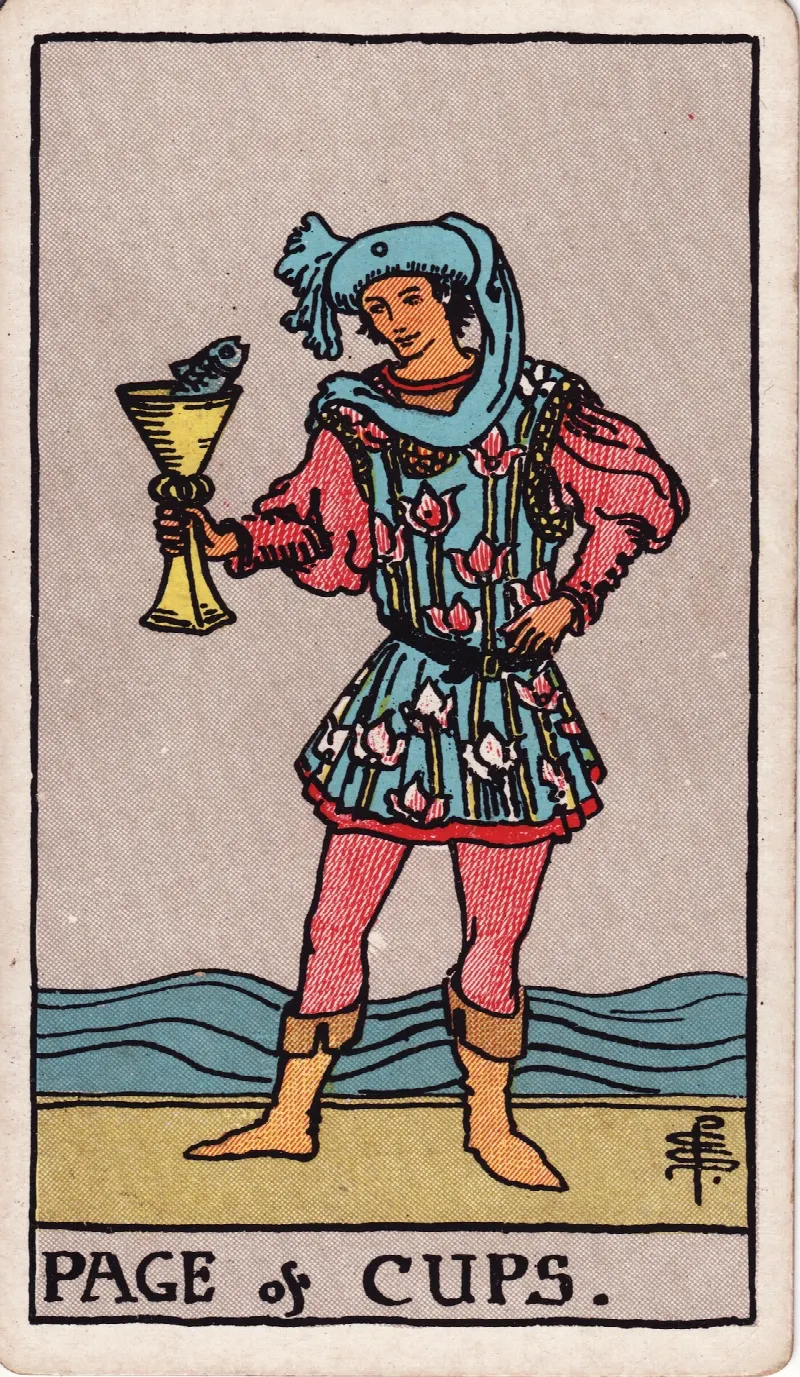
Pages, Knights, Queens and Kings can describe people in your life, but they often describe a way of approaching the situation. A useful shorthand: Pages are curious learners, Knights act and pursue, Queens nurture and understand from within, Kings lead and take responsibility. The Queen of Swords, for instance, is clear-eyed and honest; she might be a person, or she might be a reminder to speak plainly.
5. Read reversed cards gently
A reversed card is not automatically bad. Read it as the same energy, but blocked, delayed, internal or overdone. The Knight of Wands upright charges forward with enthusiasm; reversed, the enthusiasm may be scattered, impatient or stuck waiting. If reversals feel confusing at first, focus on the upright meaning and ask, "What would make this harder to express right now?"
6. Let the position shape the meaning
The position in the spread tells you which part of the question a card answers. In a three-card Situation – Challenge – Outcome spread:
- A positive card in the Challenge position might show something good that you are resisting or not using.
- A difficult card in the Outcome position is not a doom verdict; it shows where things are heading if nothing changes, and invites you to look at what you could change.
7. Tell the story between the cards
This is the step that turns definitions into a reading. Look for connections: do the cards share a suit? Does one card answer another? Is there a movement from one state to another? For example, the Four of Swords (rest) followed by the Eight of Pentacles (focused work) and the Six of Wands (recognition) tells a clear story: recover first, then build steadily, and recognition will follow.
8. Practise with one card a day
The fastest way to learn is a short daily practice. Each morning, draw one card, note your first impression and the traditional meaning, and in the evening write one line about how it showed up in your day. In a month you will have met many cards in real life, which is how meanings start to feel natural. Our guide to a daily Tarot reading practice explains how to set this up.
Common beginner mistakes
- Asking the same question again because you did not like the answer. The second draw will not be more "true"; it will only be more confusing.
- Reading cards in isolation. A list of meanings is not a reading.
- Treating Death or The Tower as literal disasters. Death usually signals an ending that clears space; The Tower, a sudden change that removes something unstable.
- Expecting certainty. Tarot shows tendencies and perspectives, not fixed events.
Practise with a guided reading
If you would like to see how an experienced interpretation connects the cards to a real question, try a free online reading. Pick your own cards, then compare your first impression of each image with the interpretation – it is an excellent way to train your eye.
Tarot is a tool for reflection and is not a substitute for professional medical, legal, financial or mental health advice.